For nearly a decade, Candy Crush Saga owned the match-3 genre with an iron grip. Then a small team in Istanbul built something better — and rewrote every rule that King thought was permanent. This is the full story of how Royal Match took the throne, and why the industry will never be the same.
"Somewhere around mid-2022, something quietly shifted in the App Store charts. The game that had held the top spot for match-3 grossing revenue — the game that became a cultural phenomenon, a household name, a billion-dollar machine — began losing ground to a title that barely anyone in the West had heard of just eighteen months earlier."
Royal Match wasn't a viral sensation. It didn't have a celebrity campaign or a Super Bowl ad. It grew through something far more powerful: word of mouth from players who couldn't believe how good it felt compared to what they'd been playing for the last ten years.
This story is bigger than two games competing for the same shelf space. It's about what happens when an industry gets comfortable. It's about how the design decisions that seemed brilliant in 2012 became the chains that held an empire back. And it's about a group of ex-game developers in Istanbul who looked at the most dominant casual game of the mobile era, saw a decade's worth of unaddressed player frustration, and decided to fix every single one of them.
To understand why Royal Match won, you first have to understand why Candy Crush was so impossibly good — and then understand, with equal clarity, why that same goodness eventually started to look a lot like a cage.
Candy Crush, 2012–2016 · The Rise of an Empire Nobody Saw Coming
To appreciate what Candy Crush Saga did, you need to transport yourself back to early 2012. The iPhone 4S had just launched. Mobile gaming was dominated by Angry Birds, Temple Run, and a handful of puzzle games. The App Store was barely four years old. Nobody — and this bears repeating — nobody had any idea that a candy-themed match-3 game would become the defining mobile game of the decade.
King was founded in 2003 in Stockholm, Sweden, by Riccardo Zacconi and a small group of developers. For almost a decade, they built casual browser games and Flash games on their own gaming portal. They were good at what they did, but they weren't exactly setting the industry on fire. They were, in the language of the era, a mid-tier casual games company trying to find their breakthrough.
That breakthrough almost didn't happen the way it did. King had been building games on Facebook — the social network was, in 2011 and 2012, the dominant platform for casual gaming. Farmville had already proven the model. Bubble Witch Saga, King's first Facebook hit, launched in 2011 and gave them their first taste of genuine viral growth. They learned the mechanics of the Facebook social graph: how friend requests spread games, how leaderboards drive competitive engagement, how the notification system could become the most powerful free marketing channel ever invented.
They were going to need every single one of those lessons for what came next.
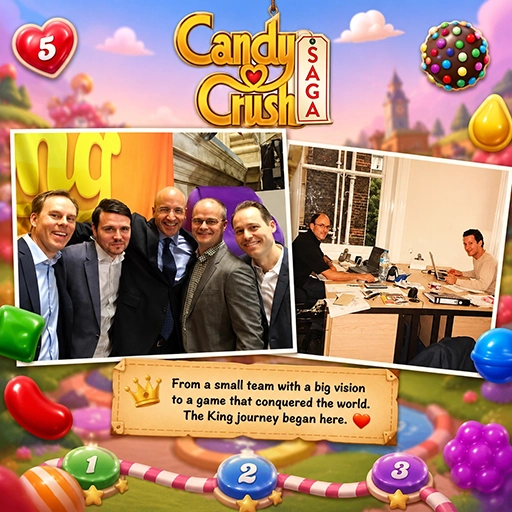
Candy Crush Saga launched on Facebook in April 2012. It was a match-3 game — swap adjacent candies to create lines of three or more, clear objectives, advance through levels. The mechanic was older than smartphones. PopCap's Bejeweled had been doing it since 2001. Nothing about the core gameplay was new.
But King did something that nobody had done quite so well before: they assembled every best practice of the era into one coherent, polished package and executed it with remarkable consistency. Candy Crush wasn't revolutionary in any single dimension. It was exceptional across all of them simultaneously. And that — as it turns out — was enough.
When the iOS version launched in November 2012, the game exploded. By the end of 2012 it was the most downloaded app on the App Store. By early 2013 it was generating $633,000 per day in revenue. By mid-2013 it had 93 million daily active users — a number that, at the time, exceeded Twitter's entire user base. King made over $1.88 billion in 2013 alone. From a free-to-play puzzle game about matching candy. Let that sit for a moment.
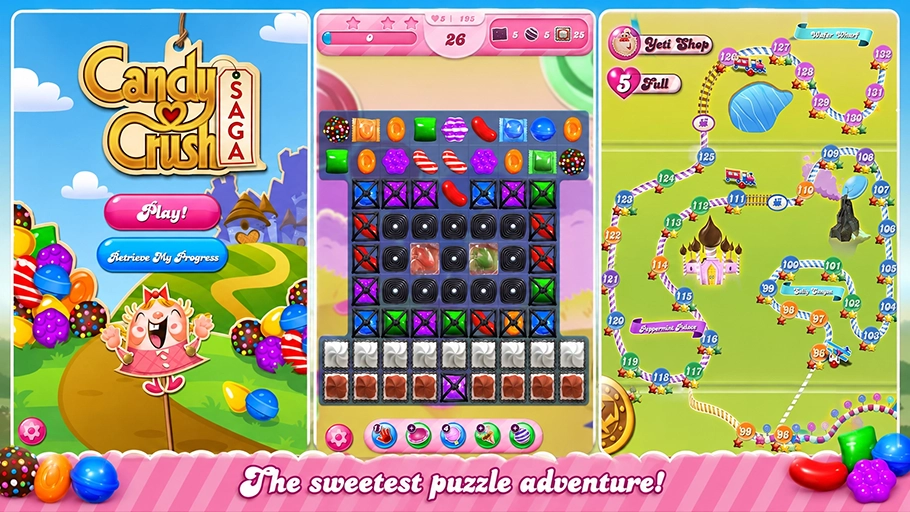
There's a revisionist tendency in game design discussions to talk about Candy Crush's success as if it were mostly luck, or mostly predatory design, or mostly Facebook's viral machinery. All three played a role. But that narrative undersells what King actually built. Candy Crush was a genuinely brilliant product for its moment in time, and understanding its brilliance is essential to understanding what Dream Games had to overcome.
The core mechanic of Candy Crush requires almost no explanation. You see a board of colored candies. You swap two adjacent ones to make a line of three. Lines disappear. New candies fall. That's it. A child can understand it in thirty seconds. King chose a mechanic that was simultaneously skill-capped high enough to be interesting and skill-floored low enough to be universal — and that universality was everything in 2012.
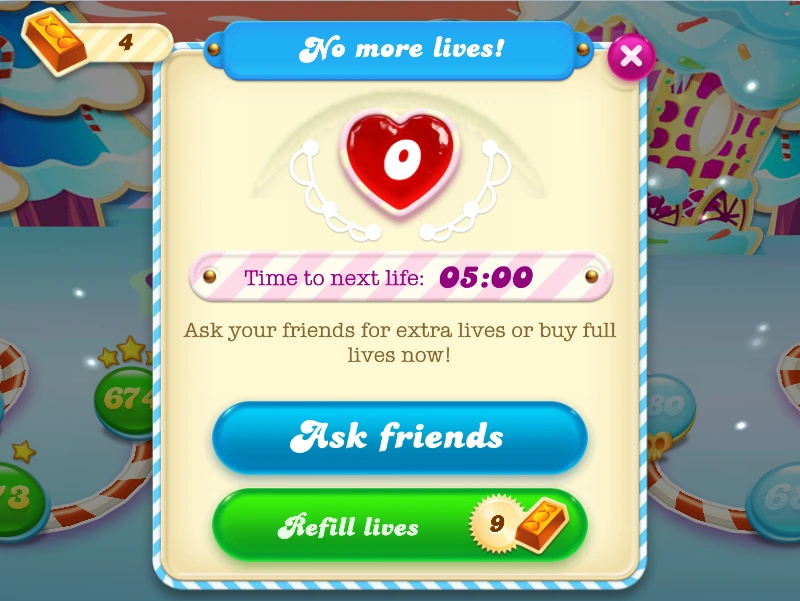
The hearts/lives system is the most controversial design decision in Candy Crush's history. Here's how it worked: you started with five lives. When you failed a level, you lost one. When you ran out, you waited 30 minutes per life — or you asked your Facebook friends to send you lives, or you paid to refill them immediately.
In 2012, this was actually clever. The Facebook integration meant that asking for lives was a natural social act — you sent a request, your friend got a notification, they clicked it and felt like they helped you, maybe they started playing too. The social layer had genuine value. Lives weren't just a paywall; they were a social interaction mechanism that spread the game virally.
But you probably already know the punchline. Facebook's game request notifications were increasingly blocked, filtered, and eventually deprecated. By 2016, most people had trained their social networks to never send them game requests again. The social scaffolding that justified the lives system had been dismantled — but the lives system itself remained, now stripped of its social dimension. What was left was pure friction.
King's lives system was not an accident or an oversight. It was a precisely designed dual-purpose mechanism: a social virality engine and a soft monetization gate, both running on the same rail. The problem was that when the social rail collapsed, only the paywall remained — and players noticed immediately.
The lives system wasn't Candy Crush's primary revenue driver — boosters were. King had designed a library of powerful single-use items: the Lollipop Hammer that smashes a single candy, the Color Bomb that clears every candy of one color, the Striped + Wrapped combination that creates a massive chain reaction. These boosters were delightful to use. They were also expensive relative to the game's own economy.
The architecture was precise. King's level designers would create a level that was genuinely completable without boosters — but just barely, at the edge of most players' skill and patience thresholds. At exactly that moment of frustration, the game would helpfully display the booster shop. The right booster would solve the level in one move. It cost a small amount. Most players would rather pay that small amount than fail the level for the seventh time. This is not a bug in the system. It is the system.
What made this work was the quality of the underlying game. The levels, for all their manufactured difficulty, were genuinely well-designed. The animation was crisp and satisfying. The sound design hit exactly the right notes of sweetness and reward. Players were not playing because they were trapped. They were playing because the game was good, and the monetization was a tax they were willing to pay for continued access to something they genuinely enjoyed.
Candy Crush, 2016–2021 · The Comfort of Success Is a Very Comfortable Trap
There's a phenomenon in tech that happens to dominant products. It's the innovator's dilemma applied not to business models but to design: the more successful a product becomes, the more terrifying it becomes to meaningfully change it. Every feature is load-bearing. Every UI element has millions of users who expect it to be exactly where it is. Every design decision that was made in 2012, good or bad, is now protected by the inertia of several hundred million player sessions per day.
After the Activision Blizzard acquisition closed in February 2016 for $5.9 billion, King became part of a publicly traded entertainment conglomerate. The game was no longer just a game — it was a financial instrument. And financial instruments don't get redesigned from scratch.
So King did what any reasonable steward of a $5.9 billion asset would do: they optimized what they had. They added levels — thousands and thousands of new levels, eventually pushing the total past 15,000. They launched spinoffs: Candy Crush Soda Saga in 2014, Candy Crush Jelly Saga in 2016, Candy Crush Friends Saga in 2018. Each was competent. None was transcendent. None moved the cultural needle the way the original had.
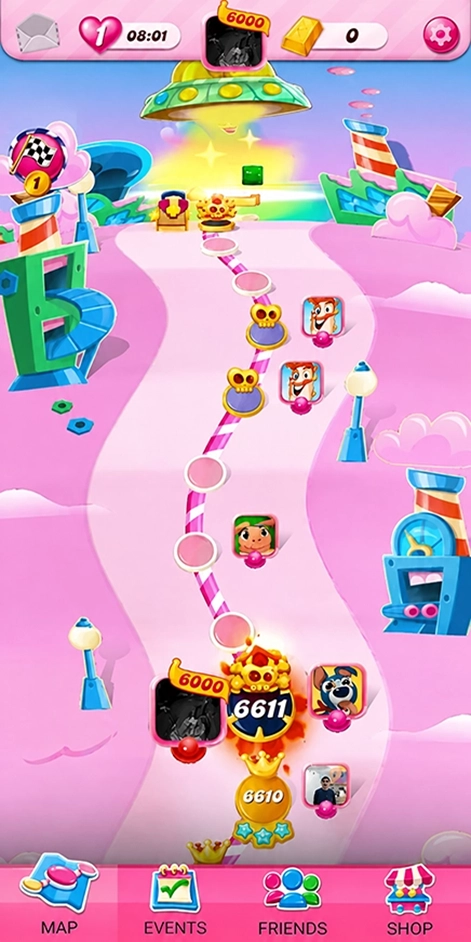
Candy Crush's core visual and interaction design was built for Facebook — which meant it was built for a browser, with a mouse, on a desktop screen. The mobile version was an adaptation, not a native design. The buttons were sized for clicks, not taps. By 2018, players using iPhones X and above had a completely different visual vocabulary. OLED screens, high-resolution Retina displays, fluid full-screen gestures — the canvas had changed completely, and Candy Crush's interface sat in the middle of it looking like a relic.
Every year King didn't rebuild its UI from scratch, the technical and aesthetic gap between Candy Crush and modern mobile design standards grew wider. By 2020, that gap was visible enough that players could feel it — even if they couldn't have named it. The game felt old. Not bad, not broken — just old. And "old" is a powerful reason to try something new.
By 2019, Candy Crush had a problem it couldn't fix with new levels or spinoffs: its player base was aging, and younger players weren't replacing them at the same rate. The game that had been downloaded 5 billion times had built its audience primarily from women in their 30s and 40s who had discovered it in the Facebook era. That audience was loyal — but the game looked exactly the same as it did when they first played it.
Generation Z approached mobile games with fundamentally different expectations. They'd grown up with Fortnite's production values, Minecraft's endless creativity, and Pokémon GO's augmented reality. They wanted games that felt alive — games with seasons and events and story progression. Candy Crush's offer — here are 15,000 levels of mostly similar puzzles, and also please wait 30 minutes if you fail — didn't land the same way with players who had so many more options.
Into this gap — between what Candy Crush was and what a new generation of match-3 players wanted — walked a group of people who had been building puzzle games in Turkey for the better part of a decade, and who were absolutely certain they could do it better.
Dream Games, 2019–2021 · The Unlikely Origin Story of the Game That Dethroned a King
Istanbul is not the first city you think of when you think of mobile gaming. Silicon Valley, Helsinki, Tokyo — these are the cities the industry articles mention. But in the late 2010s, Turkey had quietly produced one of the most impressive concentrations of puzzle game talent anywhere in the world, and that talent was clustered almost entirely inside one company: Peak Games.
Peak Games was founded in Istanbul in 2010. By the mid-2010s, their two flagship titles, Toy Blast and Toon Blast, were genuine innovations in the match-3 and blast-puzzle genre, with production values, meta-game systems, and community features that the industry hadn't seen before at that quality level.
In June 2020, Zynga acquired Peak for $1.8 billion — one of the largest mobile gaming acquisitions in history. At the time, this seemed like a clean exit for Peak's founders and employees. With the benefit of hindsight, it looks more like the moment that seeded Peak's greatest competitor.
Before the Peak Games sale closed, several key members of the Peak leadership team — including Soner Ay, who would become Dream Games' CEO — had already left to start something new. They had seen what it took to build a game that players loved, that retained well, that monetized with integrity. And they had a very clear thesis about where the market was underserved.
The thesis was simple and audacious: the match-3 genre was the biggest, most lucrative genre in mobile gaming, and its dominant player had been standing still for a decade. Dream Games was founded in Istanbul in 2019 with a stated mission that sounds almost confrontationally ambitious for a startup: "To entertain the world with the best mobile games ever made." Not pretty good games. Not competitive games. The best. They meant it.
Most gaming startups are advised to find a niche, to avoid competing with entrenched giants in established categories. Dream Games did the opposite. They deliberately targeted match-3 — the most popular, most competitive, most well-funded category in mobile gaming — and bet everything on being able to do it better than King.
Dream Games raised $50 million in a Series A round from Index Ventures before Royal Match had even launched globally. Royal Match soft-launched in Turkey and Scandinavia in late 2020. The early metrics were extraordinary — better Day-1 and Day-7 retention numbers than the industry had seen for a match-3 game in years. Players were not just downloading it; they were coming back. And they were coming back not because they were hooked by manipulation, but because the game was genuinely more enjoyable than anything else in the category.
Riccardo Zacconi and co-founders start building casual browser games. A decade away from being worth billions.
Within weeks it's the most downloaded free app on the App Store. The phenomenon begins.
The peak of the Candy Crush empire. No other game in the world comes close to these numbers.
One of the largest gaming acquisitions ever. King becomes a division of a publicly traded entertainment giant.
Soner Ay and ex-Peak Games talent start building. Their target: the match-3 genre's unaddressed player frustrations.
Early retention metrics exceed industry benchmarks. Index Ventures bets big on the challenger.
The game reaches #1 in multiple markets within months. Dream Games valued at $1B+ by year end.
Dream Games raises $255M at a $2.75B valuation. The throne has changed hands.
What Royal Match Actually Changed · Ten Design Decisions That Rewrote the Genre
Everything in this section is a direct comparison — what Candy Crush decided and why, versus what Royal Match decided instead and why that worked better. Some of these are small differences that compound into a completely different player experience. Others are single decisions that, by themselves, changed the genre. All of them were intentional.
This is the single biggest structural difference between the two games, and in many ways everything else flows from it. Candy Crush's answer to "why should I keep playing?" is, essentially: "there are more levels." After you beat level 500, there are levels 501 through 15,000. The problem is that infinitely more of the same thing isn't the same as having a reason to play.
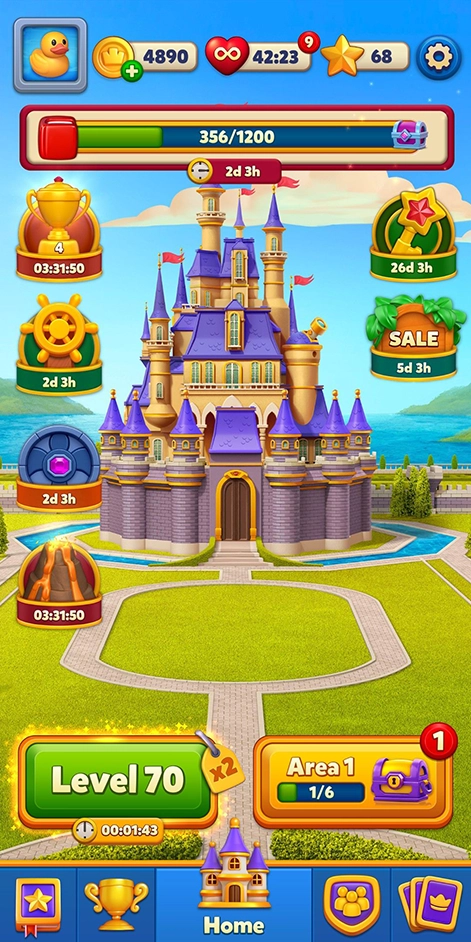
Royal Match answered the same question completely differently. Every level you complete earns you stars. Stars are spent on a renovation project — restoring and decorating a royal castle. The castle has hundreds of distinct areas: the great hall, the library, the garden, the throne room. Each area has several renovation options, and you choose between them, making meaningful aesthetic decisions. After renovation, each area has a short animated vignette that celebrates the transformation.
The effect of this design on player psychology is enormous. Candy Crush's progress is measured in an abstract number — level 847. Royal Match's progress is measured in a space you have personally shaped. You didn't just clear 847 levels; you built a garden. You restored a library. You decorated a throne room. This is yours in a way that a level number will never be.
Your progress in Candy Crush is quantified by which level you're on. Level 2,450 means you've played a lot. It doesn't mean anything has been built. There's nothing to look at that feels like yours. The game offers no container for pride or ownership — just a continuing counter with no endpoint that means anything.
Every completed level adds to your castle restoration project. You choose how each area looks. You see the before and after. The castle reflects your time invested in a way you can show other people. This is my castle is a sentence no Candy Crush player has ever said. Every Royal Match player has.
Players who have built something inside a game don't leave it lightly. The castle meta-game is a retention mechanism disguised as a creative feature. Every decoration decision a player makes increases their sunk cost — but unlike traditional sunk cost design, this one creates genuine pleasure alongside the investment.
In 2021, giving players truly unlimited lives in a match-3 game was not an obvious decision. Every major player in the genre gated play behind a scarce life counter. The entire monetization infrastructure of the genre had been built around managing that moment of scarcity — when you run out, you pay or you wait. Dream Games looked at that model and built the opposite.
In Royal Match, you have unlimited lives at all times. Fail a level? Try it again — immediately, for free, as many times as you need. The game never puts a timer between you and the next attempt. The focus isn't on selling you lives to keep playing; it's on making the game so enjoyable that you want to spend on boosters, cosmetics, and season passes because you're having a great time — not because you're trapped behind a wall.
The psychological effect of this is profound. When players aren't in a constant state of scarcity and frustration, they make entirely different spending decisions. The research literature on consumer psychology is unambiguous: people who feel respected and in control spend more willingly and more frequently than people who feel cornered. By giving unlimited lives freely, Dream Games replaced resentment with goodwill — and players who feel goodwill spend generously.
Fail five times and you stop playing. Wait 30 minutes per life, or pay, or spam your friends. In 2012, the friends option worked. By 2019, your friends hate game requests and what's left is a pure friction wall disguised as a design feature.
Royal Match gives every player unlimited lives at all times — no waiting, no paying, no asking friends. The focus is never on selling you the ability to keep playing. It's on making the game so good that you want to spend on the extras. Players who are never frustrated spend more freely, and more happily.
Giving unlimited lives doesn't reduce revenue — it shifts what players are willing to spend on. When the game never corners you, you stop resenting it. Royal Match's monetization is built on boosters, cosmetics, and season passes that players buy because they're enjoying themselves — not to escape frustration. The per-user revenue metrics are strong precisely because the spending context is positive.
Open Candy Crush Saga and Royal Match side by side and the first thing you notice isn't any specific feature — it's how differently each game feels. One looks like a bright, flat, slightly garish confection that would have been at home on a 2012 browser page. The other looks like a Pixar short film running on your phone.
King's visual design language was established in 2012 and has been incrementally updated but never fundamentally rethought. On an iPhone 14 Pro's ProMotion display at 120Hz, it looks like a web game from another era. The resolution is there. The fidelity is there. The visual philosophy isn't.
Royal Match approached visual design as if mobile screens had never been anything but the premium displays they are in 2021. Every surface has proper lighting and shadow. The castle environments are rendered with warm, inviting depth — stone arches, garden light filtering through foliage, candlelit libraries. The character animations have personality and follow-through. The explosions and combos are designed with what game designers call "juice" — the surplus of satisfying feedback that makes a simple action feel meaningful.
Flat, brightly colored, high-saturation candy world. Designed for small screens and slow processors. The aesthetic communicates "approachable and casual" — which is correct — but also communicates "this is not a premium product" in 2021.
Three-dimensional assets with proper lighting, ambient occlusion, and material depth. Warm, inviting color grading. Particle effects with physical plausibility. The visual design says "this was built for your phone in 2021" — and players feel that in every session.
Over thousands of levels, certain patterns emerge in Candy Crush that experienced players recognize as deliberate difficulty spikes — moments where the random candy drop or the board configuration creates near-impossible situations that players can only escape with boosters. Whether or not the difficulty spike is mathematically intentional, the player's experience is that the game suddenly got arbitrarily hard in a way that feels like it's asking them to open their wallet.
This perception — the sense that difficulty is manufactured rather than organic — is one of the most corrosive forces in player psychology. Once a player believes the game is playing against them rather than challenging them, the social contract of fair play is broken. Spending on boosters shifts from "I want this shortcut" to "I'm being extorted for this shortcut."
Dream Games built their level design philosophy around the opposite assumption: every level should be completable without boosters, and boosters should feel like smart strategy rather than surrender. Players report more frequently that hard levels feel genuinely challenging rather than unfairly designed.
Players who believe a game is fair will spend money on it gladly. Players who believe a game is rigged against them resent every dollar they spend. Royal Match's level design philosophy isn't just a UX decision — it's a business decision. The lifetime value of a player who trusts your game is dramatically higher than the lifetime value of one who doesn't.
Candy Crush has a mascot — Tiffi, a small girl who appears on the loading screen and in the earliest levels. But Tiffi's function in the game is purely decorative. She's a visual brand element, not a character. Players feel nothing about Tiffi.
Royal Match has Duke Robert. The Duke is the castle's owner — an earnest, enthusiastic nobleman who is renovating his ancestral home with your help. He reacts to your choices. He celebrates your victories. He appears throughout the game's meta-content with a consistent personality: warm, slightly bumbling, genuinely grateful for your help.
The presence of a character creates an emotional dimension to the meta-game that pure aesthetic customization can't provide on its own. Players develop a mild but genuine affection for Duke Robert. The castle doesn't just belong to the player — it also belongs to him, and making it beautiful for him adds a social-emotional dimension to the renovation activity.
Tiffi exists as a brand emblem — visual consistency across marketing materials and loading screens. She has no personality expressed through gameplay, no goals the player cares about, no narrative role. Players feel nothing about her.
Duke Robert is a genuine game character with consistent personality and emotional presence. He reacts, he thanks you, he celebrates. Mild and light as he is, he creates a social-emotional dimension that transforms renovation from an abstract activity into helping someone you like.
Both games have boosters. Both games sell boosters for real money. The similarity ends there. Candy Crush's boosters are primarily purchased items. The store appears prominently at moments of difficulty. The relationship between the game and boosters is transactional: you fail, you spend, you advance. The booster's presence is inseparable from the frustration of failure.
Royal Match's booster economy is built on a different philosophical foundation. Boosters are earned regularly through normal play — through level completion stars, through team events, through daily rewards. Players are encouraged to use boosters strategically because they have a meaningful supply of earned ones. Spending real money on boosters exists as an option — but it doesn't feel like the intended or primary path.
The result is that Royal Match players feel powerful more often. They feel clever when they use the right booster at the right moment and pull off a difficult level. The emotional experience of "I earned this booster and used it well" is dramatically more positive than "I spent $0.99 to avoid failing this level again." Both are valid monetization touchpoints — but one builds brand loyalty and one erodes it.
In 2021, Candy Crush's social layer had largely dissolved along with Facebook's gaming ecosystem. What remained was a game that was fundamentally solitary — you played alone, you competed for level position alone, you progressed through a private narrative of level numbers that nobody else could see or celebrate with you.
Royal Match built a genuine social layer from scratch. Team events are the centerpiece of this: players join teams and collectively work toward group goals — completing a certain number of levels, earning a certain amount of stars, scoring points in limited-time tournaments. These team events create a dynamic that individual play cannot: the sense that your actions have consequences for others, and that others' actions benefit you.
This is the external accountability principle from retention design applied as a social feature. When your team is 500 stars away from the prize and the event ends in 3 hours, you play those three extra levels you wouldn't have played otherwise. Royal Match built team events into the core progression economy from the beginning — they weren't an add-on.
The single most effective retention mechanism in mobile gaming is external accountability — a social obligation that brings players back even when they weren't intending to play. Royal Match's team events create this obligation by design. It's the same principle that makes guilds in MMOs so powerful for retention, applied to a casual mobile game.
Candy Crush's onboarding was designed when mobile games were new and players needed guidance. The early levels function as a tutorial: here's how to match, here's what a striped candy does, here's how a color bomb works. The instruction is patient, thorough, and somewhat patronizing to anyone who has ever played a match-3 game before — which in 2021 is essentially everyone who would download a match-3 game.
Royal Match's onboarding leans into the assumption that its players are adults who know how games work. The early levels introduce mechanics through play, not through text boxes. More importantly, Royal Match front-loads the fun. Within the first three levels, players have experienced a big combo, earned stars, and started their first renovation. The emotional hook of the meta-game is set before the game has asked for anything in return.
Early levels walk through every mechanic individually with text overlays and forced actions. In 2021, it feels like explaining a handshake to someone who's been shaking hands for a decade.
The first session delivers fun within 90 seconds, castle context within five minutes, and a meaningful renovation result before the player has a chance to reconsider. Players feel smart for figuring it out rather than lectured through a mandatory curriculum.
Here's the sentence that makes game finance people uncomfortable: treating players with respect is a better monetization strategy than exploiting their frustration. Royal Match proved this empirically. Its revenue-per-user metrics are competitive with or superior to Candy Crush's — achieved through a fundamentally less aggressive monetization architecture.
Candy Crush's monetization model is built around manufactured scarcity and friction. Lives create the scarcity; the store removes it for a price. Difficulty spikes create frustration; boosters resolve it for a price. The emotional context of spending is almost always negative: you spend to escape a bad feeling.
Royal Match's monetization is structured around positive context wherever possible. The season pass offers cosmetic rewards and extra stars — players buy it not to escape frustration but to get more of something they already enjoy. The occasional "extra moves" prompt during a difficult level is a genuine offer of assistance rather than a trap door over a pit of frustration.
Game designers use the word "juice" to describe the surplus of satisfying feedback that makes a simple mechanical action feel meaningful and rewarding. Juice is the screen shake when something explodes. It's the coin shower that erupts when you complete a level. It's the musical swell that punctuates a big combo. Juice is, in many ways, the felt experience of a game — the part that your body responds to before your conscious mind has processed the game state.
Candy Crush is not without juice — in 2012, its candy-popping animations and musical feedback were genuinely satisfying. But over a decade without fundamental redesign, those animations and sounds have become familiar to the point of invisibility for long-term players.
Royal Match's designers approached juice as a first-class design problem. Every power-up has distinctive, escalating visual feedback. The Royal Bonus — delivered when a player makes especially clever moves — has a genuinely exciting animation that makes the player feel seen and rewarded by the game itself. The level completion sequence is a mini-celebration, not a checkbox. Sound design is equally considered — Royal Match's audio environment is warm and regal, matching the castle aesthetic in a way Candy Crush's candy-popping sounds never quite achieved.
Data · Revenue · Rankings · When the Throne Changed Hands
Revenue rankings in the App Store and Google Play are the most objective measure of which match-3 game players were willing to spend money in. These numbers don't care about which game has better reviews or which design philosophy is more respectful of players. They're the market's verdict, registered in aggregate through millions of individual spending decisions.
By mid-2022, Royal Match had become the #1 grossing match-3 game in the United States, the United Kingdom, Germany, and several other major markets. This wasn't a brief surge or a viral moment — it was a sustained position that held and grew as the year continued. By the end of 2022, there was no serious debate about which game was generating more revenue in the category. Royal Match had taken the crown that Candy Crush had held for most of the previous decade.
Numerical ratings tell you very little. Review text tells you everything. Pull up both games' App Store reviews and read them qualitatively. Candy Crush's reviews, even the positive ones, are flavored with a specific kind of resignation: "I've played this for years," "addictive but frustrating," "would be perfect without the hearts system."
Royal Match's reviews have a qualitatively different emotional register: "feels fair and fun," "love the castle," "I don't feel manipulated," "finally a match-3 that respects the player." New players discovering it write reviews that sound like relief — relief that a game in this genre finally feels like it's on their side. That emotional quality doesn't show up in a star rating. It shows up in Day-30 retention and lifetime value, which is why Dream Games is a $2.75 billion company and not a promising startup.
Lessons, Legacy, and What Comes Next for Both Games
The story of Candy Crush's decline is not really about Royal Match. It's about what happens when a product team optimizes a system for too long without reimagining it. Every quarter that King chose to add levels rather than rethink the meta-game was a quarter that widened the gap between what Candy Crush offered and what players actually wanted.
Incumbents in any market are almost never beaten by someone doing the same thing better. They're beaten by someone who looks at the entire system the incumbent has built — including the parts that have been there so long they're invisible — and asks which parts are actually serving players and which parts are serving the business model of 2012.
King is not a bad company full of bad designers. They are a very large, very profitable company with a very successful product that is protected by both the inertia of success and the genuine risk of breaking something that still makes hundreds of millions of dollars per year. Dream Games had none of those constraints. They could start with the player experience that 2021 demanded and work backwards to the business model.
Lesson 2King's executives, if they were being honest in private, have almost certainly known for years that the lives system was damaging retention. They have the data. They can see that the frustration spike at the moment lives run out correlates with a percentage of players making a permanent exit decision.
But they couldn't remove it. The lives system is load-bearing infrastructure in Candy Crush's monetization architecture. Rebuilding the monetization model around a world without lives would require rebuilding the entire economic balance of the game. It would be, in essence, building a different game while maintaining the branding and player base of the original.
Dream Games had no such constraint. They started with "unlimited lives, always free" as a founding assumption and built their entire monetization model around it. The lesson the industry is learning is that design decisions are far easier to make at founding than to reverse in production — and the most important ones are often the ones that cost you a legacy revenue stream.
Lesson 3Candy Crush was, at its peak, a system for managing player flow: metering their access to fun, creating strategic friction, delivering rewards at precisely calculated intervals. It was designed like a casino — optimized to keep players engaged at exactly the level of frustration that maximized spending without triggering abandonment. It worked brilliantly for years. And then the players got wise to it.
Royal Match was designed to delight. When your design team's primary question is "how do we delight the player at this moment?" rather than "how do we maximize the probability of a purchase at this moment?", you end up making different choices across every touchpoint of the game. Most of them add up to a product that players recommend to their friends, not one they eventually resent.
Where This Goes NextKing is not standing still. Candy Crush has been actively updated, new events added, live operations expanded, and various monetization experiments tested. The game still generates substantial revenue from a large and loyal player base. The question is not whether Candy Crush is dead — it isn't — but whether King can execute the fundamental design rethink that would make it genuinely competitive with Royal Match on player experience terms.
Dream Games, for their part, have used Royal Match's success to begin work on additional titles. Their ambition is not to be a single-game studio; they want to be a top-tier mobile gaming company building multiple world-class titles. With $255 million in the bank, a proven track record, and a team that has now demonstrated it can beat the best in the world, they're positioned to make that ambition real.
The broader match-3 genre is going through a genuine renaissance as a result of Royal Match's success. Studios that had been comfortably copying Candy Crush's model are being forced to answer the question that Dream Games answered first: what does a match-3 game designed for today's players, with today's expectations, look and feel like? The answers are starting to emerge, and they all look more like Royal Match than like Candy Crush.
Royal Match is now, in some small way, the incumbent. Its design decisions — the castle meta-game, unlimited free lives, the team events — are being imitated by the next generation of challengers. In five years, some team somewhere will look at Royal Match's design and ask the same question Dream Games asked about Candy Crush: which parts of this are still serving players, and which parts have just been there too long to question?
"King built a machine. Dream Games built a world. Players chose the world."— The one sentence that explains the entire match-3 revolution
Candy Crush Saga is not a bad game. In 2012, it was arguably the best game in its category by a wide margin. The design decisions that defined it — the lives system, the social Facebook layer, the difficulty spike monetization, the level-number progression — were intelligent, well-executed responses to the market conditions and player expectations of their era.
But mobile gaming changed. Players changed. Screens got better. Expectations rose. The design decisions of 2012 were built on assumptions that gradually became false — assumptions about the social function of Facebook, about what players would accept in terms of friction, about how much players cared about visual quality, about whether meta-game progression mattered in a casual mobile context.
Dream Games didn't have better technology than King. They didn't have more money or more experience or a more famous brand. What they had was the freedom that comes from starting fresh — the ability to look at a decade's worth of player frustration and design every response from scratch, without any legacy decisions to protect. They used that freedom to build a game that addressed every frustration Candy Crush players had been accumulating for ten years. The players noticed. The charts confirmed it. The crown changed hands.
The most important lesson isn't about match-3 games or mobile gaming or even design philosophy. It's about what happens to any product when the team building it has too much to lose from the truth. King's designers knew the lives system was increasingly toxic. They knew the UI was dated. They knew the meta-game was thin. But knowing and acting are very different things when you're managing a system that earns a hundred million dollars a year. Dream Games acted because they had nothing to lose by acting. That freedom was worth more than any number of level designers or marketing dollars.