In January 2026, Scopely quietly dropped a number that deserved louder headlines than it got: a mobile game based on a board game your grandparents own had crossed $6 billion in lifetime player spending — faster than any mobile game in history, full stop, beating out juggernauts like Honor of Kings, Clash of Clans, and Monster Strike to the milestone.
The game is MONOPOLY GO!. It has no shooting, no base-building, and roughly the strategic depth of a coin flip. You roll dice. A little token moves. Numbers go up. That's it. That's the whole game. And yet it is, by a wide margin, one of the most successful pieces of entertainment software ever built, with 70% of its players returning to play again every single day — a retention number that makes most "daily habit" apps look like they're barely trying.
There's a version of this story that stops at "nostalgia plus luck," and moves on. That version is wrong, or at least badly incomplete. What actually happened took six years, two entire scrapped games, a deliberate stripping-out of everything that made the original board game intellectually interesting, and a replacement built with unusual precision around a short list of well-documented psychological levers. Nobody stumbled into $6 billion. They engineered their way there, one failed prototype at a time.
For context: Candy Crush Saga needed years of steady compounding to become a cultural fixture. Clash of Clans built its empire brick by brick over the better part of a decade. MONOPOLY GO! did more in lifetime revenue than either of those all-time giants in roughly a third of the time — on a license that's been sitting in toy store aisles since 1935, run by a studio most casual players had never heard of before April 2023.
This is the story of how that happened: the six wasted years and two scrapped prototypes before anyone found the fun, the psychology stacked underneath every roll, and the actual numbers behind a habit that's now closing in on $8 billion.
MONOPOLY GO! looks like it was built in a weekend. It was not. The real story starts around 2016, and for the first several years, it is mostly a story about getting it wrong.
Scopely itself goes back further than that — founded in Culver City, California in 2011, building a quiet but steady business on titles like Star Trek Fleet Command and Marvel Strike Force. By 2019, the company had already crossed $1 billion in lifetime revenue. Scopely wasn't new to Hasbro's toy box either — the studio had already shipped Yahtzee With Buddies in 2017 and Scrabble GO in 2020. MONOPOLY GO! would be the third collaboration, and by far the biggest swing.
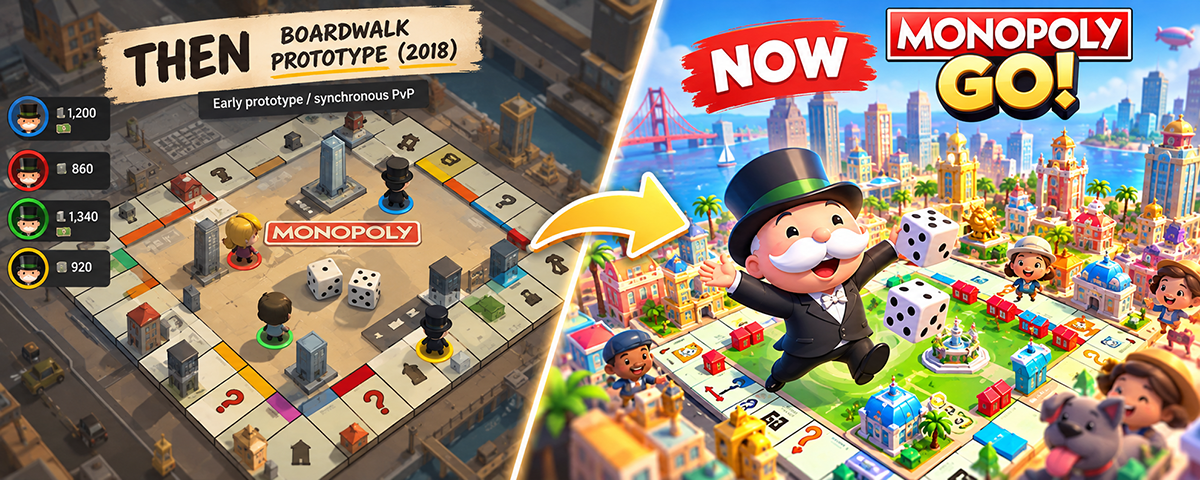
The first attempt, internally codenamed Boardwalk, was a synchronous PvP game — something closer to Clash Royale than Monopoly, requiring real skill and quick strategic decisions to build wealth against an opponent in real time. It's a completely reasonable instinct: Monopoly is a game about besting your friends out of their money, so why not build that directly into a competitive mobile loop?
Massimo Maietti, the Scopely veteran who'd end up leading the whole project, almost didn't take the job. He was happily running things as creative director at Zynga in San Francisco, working on FarmVille 2, when Scopely came calling in 2016. He said no. They kept asking. Eventually he said yes — and inherited a team working out of, by lead designer Jeff Liu's own account, a few cubicle walls thrown up in a hallway on the way to the office bathroom.
Boardwalk shipped to soft-launch. It was fine. Maybe even good. "We made an OK game… maybe a good game, but not the great game that the audience for Monopoly wanted," Maietti later admitted. It demanded exactly the kind of fast, skillful, competitive decision-making that made it a great fit for core gamers and a terrible fit for the actual Monopoly audience: casual, often older, playing in short bursts, with zero interest in out-micromanaging an opponent. So the team did something most studios never get the budget or the nerve to do: they killed it, and started completely over.
The second attempt was codenamed Top Hat — named, like the rest of the game's internal lore, after a piece on the actual Monopoly board. Where Boardwalk had demanded skill and strategy, Top Hat stripped all of that away. Roll dice. Move automatically. Let luck, not tactics, decide what happens next. It felt like a demotion. It turned out to be the entire insight: Monopoly's appeal was never really the negotiation or the strategy. It was the emotional swing of watching your fortunes rise and fall against people you actually know — what Maietti has described as the game's "perils of wealth," the same messy mix of money and relationships that makes a kid bankrupting their own father feel funny instead of cruel.
The art direction followed the same logic. Art lead Howard Shin has pointed out that Monopoly doesn't carry deep lore or narrative the way a fantasy IP might — so instead of inventing a backstory nobody asked for, the team leaned into the one thing the brand already had in abundance: comedy, and the faint, cartoonish menace of its mascot. Hence a world called GoVille, and a Mr. Monopoly who seems to take genuine delight in your financial ruin.
Speaking at GamesBeat Summit alongside game-design consultant Amy Jo Kim, Maietti and Shin offered a line that sounds almost like a confession: building a hit out of an established IP is, in their framing, "almost not about the game at all." Monopoly didn't need Scopely to prove it was fun — a 90-year-old institution with a billion-plus lifetime players had already settled that question. What it needed was a team willing to figure out which specific emotional core of that institution — not the rules, not the board, but the rush of getting effortlessly richer than the people you love — would actually survive the jump to a phone screen.
By the time MONOPOLY GO! actually launched, the project had consumed roughly six years, two full prototypes, and a team that had grown from a hallway to more than 500 people spread across Los Angeles, Colorado, Seville, Israel, the UK, and Ukraine.
"We made an OK game… maybe a good game, but not the great game that the audience for Monopoly wanted." — Massimo Maietti, Creative Director, Scopely
MONOPOLY GO! launched on April 11, 2023. Within its first day, it had cleared 500,000 downloads. Within its first month, more than 20 million — pulling in roughly $17 million in that opening stretch alone, enough to land it in the global top 10 almost immediately.
Here's the detail that makes the timing almost comedic: six days before launch, Saudi-backed Savvy Games Group announced it was acquiring Scopely outright for $4.9 billion — at the time, the sixth-largest M&A deal in games industry history. The deal was built on Scopely's existing portfolio, not on a game nobody outside the building had played yet. Within about two years, MONOPOLY GO! alone would generate roughly as much in player spending as Savvy had just paid for the entire studio.
The acquisition closed that July, with Scopely continuing to operate as its own business unit under co-CEOs Walter Driver and Javier Ferreira. Savvy's CEO called it the largest investment the fund had made to date — a bet placed on Scopely's overall track record, only days before that track record was about to get a lot more interesting.
By November 2023 — seven months in — the game had crossed $1 billion, officially making it the single biggest mobile game launch of that year. By March 2024, ten months in, it hit $2 billion, backed by a marketing spend that had already climbed past $500 million. 2024 alone brought in $2.5 billion in player spending, the single highest total of any mobile game that year, for any game, in any genre.
And it never really slowed down from there. A year and a half after launch, Scopely's own chief revenue officer was telling industry press that the game was performing better than it had at launch — not worse, not flattening, better — a claim most live-service games can't make a year after their honeymoon period ends, let alone two.
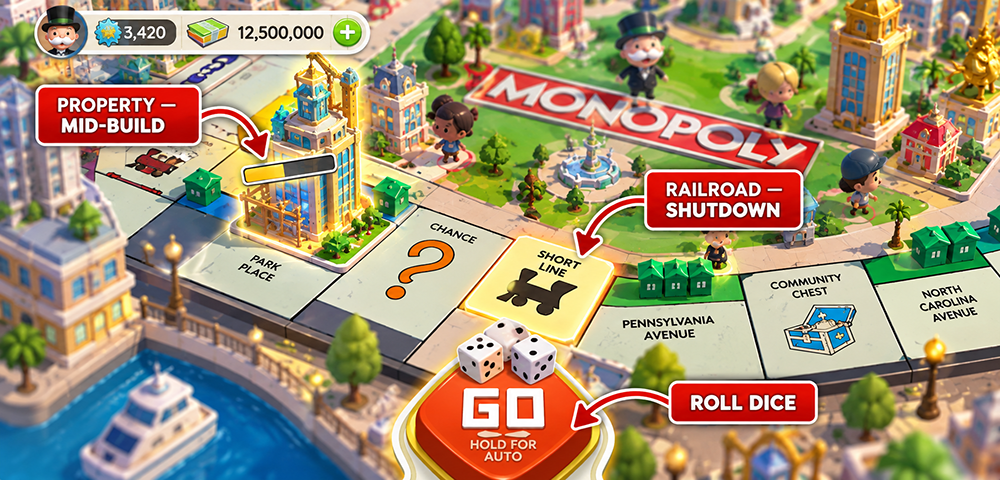
If you've never opened it, here's the entire rulebook in one paragraph: you pick a token, you roll dice, and your piece moves automatically around a themed board — first a cartoon New York, then London, then onward through a rotating world tour of cities. Land on a property tile, and you can build it up into a little landmark. Land on a Railroad, and you're dropped into one of two mini-games: a Bank Heist, where you steal cash directly from a friend's account, or a Shutdown, where you temporarily disable one of their buildings so it stops earning them rent. Land in Jail, and you're rolling for doubles to escape.
Layered on top of that simple loop is a genuinely relentless events calendar. Daily quick wins. Tournaments lasting 24 or 48 hours, pitting you against 50 to 100 other players for leaderboard prizes. Team-based "partner" events that need you to recruit real friends — some require as many as five people pitching in together just to crack open a single shared reward. Short-fuse mini-events that spike the value of a specific action for an hour or two at a time. At almost any given moment, two or three of these are running simultaneously, each one quietly nudging you to spend one more dice roll before its particular clock runs out.
The whole thing is also reskinned constantly. Seasonal sticker albums rotate every few weeks under new themes — a fairytale-themed season called Monopoly Ever After, crossover tie-ins with outside franchises, and recurring community favorites like the Golden Blitz, a short trading window where players can finally swap the rarest gold-tier stickers they've been hoarding. None of these individually matter much. Collectively, they mean there is functionally never a moment where the game has nothing new to dangle in front of you.
The stickers deserve their own mention, because they're arguably the real engine of the whole operation. Players collect themed albums, divided into sets, earned through packs that drop from events and purchases. Duplicates become a kind of informal currency, tradeable with friends to fill out the sets you're missing. It is, functionally, a trading-card economy bolted onto a dice game — Panini World Cup stickers with a rent-collection mechanic attached.
It's worth pausing on something easy to miss because it isn't a feature at all — it's an absence. The physical Monopoly board game is, by widespread reputation, a genuine time commitment: a full session routinely runs two to four hours, needs somewhere between two and eight people physically in the same room, and has a well-earned cultural reputation for ending family game night in an argument. That friction isn't a minor detail. It's most of the reason Monopoly, despite near-universal brand recognition, wasn't exactly most people's go-to weeknight activity.
MONOPOLY GO! throws almost all of that away. A single turn takes seconds. You can play entirely solo and still make progress, with the social features layered on as an option rather than a requirement to start. There's no need to gather a quorum, clear an evening, or find a flat surface big enough for the board. The "game night" version of Monopoly needed to clear a remarkably high bar of coordination before anyone rolled a single die. The mobile version needed a thumb and eleven free seconds.
That compression is arguably the single biggest unlock in the entire redesign, bigger than any individual psychological trick layered on top of it. Scopely didn't just port a board game to a screen. It took a product with brutal real-world friction and rebuilt it from scratch around the actual shape of how people use their phones: in short, scattered, asynchronous bursts, dozens of times a day, often while doing something else entirely — standing in a checkout line, waiting for a kettle to boil, half-watching television.
The biggest redesign decision wasn't adding anything new — it was removing the two-hour time commitment. Compressing a board game into 11-second turns is what made a billion-dollar daily habit possible.
Here's the detail game designers love about MONOPOLY GO!'s development: the team didn't just build a psychological hook. They named the phases of building it, internally, in a way that reads like they knew exactly what they were doing.
Before any economy, any sticker, any social feature existed, the team obsessed over one single thing: making the dice roll itself feel incredible. Every roll has its own animation, its own sound design, its own little haptic punch — regardless of whether you land on something good. This is the game's variable-reward engine running in its purest form. Outcomes are unpredictable (will it be a property, a heist, a tax hit?), but the feeling of rolling is consistently, reliably satisfying, every single time. That combination — unpredictable outcomes wrapped around a guaranteed-pleasant action — is close to the textbook definition of what keeps a slot machine profitable, minus the slot machine.
Once the roll itself felt good, the team layered on an economy designed around one specific feeling: effortless, compounding wealth. You build a hotel. People land on it. You get richer, automatically, while barely doing anything. Complete a city's board — all of Mr. Monopoly's little landmarks fully built — and you level up to a new one, where the numbers simply get bigger. It's the goal gradient effect and the endowed progress effect running at the same time: there's always a visible, nearly-finished board calling you back, and the game continually makes sure you can see exactly how close you are to finishing it.
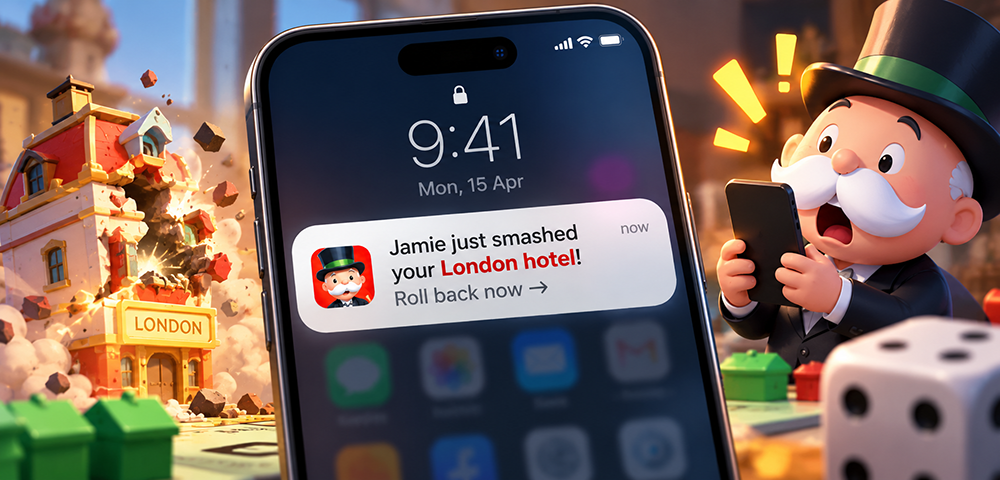
Then there's the social layer, which turns loss aversion into a push notification. When a friend Shuts Down one of your buildings, you get an alert — something has been taken from you, by a specific person you know, and you can see it happening in real time. The obvious response is to roll back and hit them right back. Scopely's own team has described the resulting emotional loop in almost exactly these terms: greed, dedication, and a little bit of fear, repeating in a tight cycle that needs no skill at all to keep spinning. It's a notably different flavor of loss aversion than a battle pass's ticking season clock — here, the "loss" has a face attached to it. It isn't an abstract deadline. It's your cousin, or your coworker, or the friend who's always a little too competitive at board game night.
Anyone who ever filled a physical sticker album as a kid already understands the next layer intuitively: finishing a set is deeply satisfying right up until the last one or two slots, at which point it becomes borderline torturous. Packs hand out duplicates far more often than the specific card you need, by design, so the album that felt 90% done after an hour can sit at 90% done for a week. Psychologists call the broader pattern a near-miss effect — the brain treats "almost finished" as functionally different from "not started," and keeps you engaged specifically because the gap feels small even when, statistically, it might not be.
None of this would hit as hard in a single-player game. Tournaments post rankings visible to everyone competing. Partner events show who's pulling their weight and who's coasting. A fully-built landmark sits there, permanently visible, as a small public monument to how much time (or money) you've put in. MONOPOLY GO! borrows a trick casual social games have used for over a decade — make progress legible to other people, and you've added a second currency, status, that doesn't cost Scopely anything to print but motivates spending almost as effectively as the first one does.
Most habit-forming apps treat a lapsed player as someone to punish — streaks reset, progress decays, the penalty for stepping away compounds the longer you're gone. MONOPOLY GO! does close to the opposite. Step away for a week, and you're typically welcomed back with catch-up bonuses, a pile of accumulated free dice, and whatever event happens to be running that day. You're never locked out. You're just quietly made to feel like you're missing something — which, as any battle pass designer could tell you, is a far more durable hook than a hard penalty ever is.
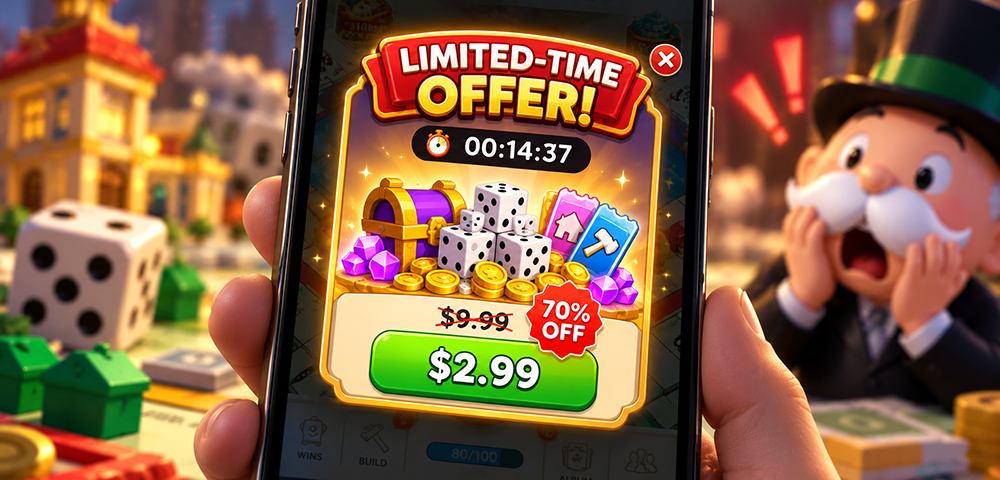
One last, quieter trick: dice rolls, the game's core currency, are sold in bundles priced in real money but denominated in made-up numbers — hundreds, thousands, sometimes millions of rolls per purchase. Divorcing the purchase from a clean, memorable dollar figure is a well-worn mobile-monetization habit for a reason: it's much harder to feel the sting of a $49.99 charge when what you're actually looking at on screen is "2,400 dice," a number with no obvious real-world price tag attached. Bundle that with limited-time price cuts on those same packs — the classic "was $19.99, now $9.99" framing — and the dollar amount becomes almost an afterthought next to the apparent deal.
"Nobody rolls dice because they love probability. They roll because the game made rolling feel good long before it ever asked for a dollar — and by the time it did ask, quitting felt like the bigger loss." — DeepGameDive Analysis
Strip away the psychology for a second and just look at the climb. No mobile game has ever gone from launch to this kind of money this quickly, and the industry has noticed: analysts tracking the game's rise have repeatedly pointed to the same short list of factors — a blend of casual mechanics with the compulsion loops more commonly seen in social-casino apps, live-ops events shipping on a weekly cadence most studios can't match, and an IP so universally recognized it never had to spend a dollar explaining what it was.
Put the download and revenue figures side by side and the efficiency becomes almost absurd: roughly 150 million total downloads against more than $6 billion in lifetime spending works out to something in the neighborhood of $40 in average lifetime revenue per install — a figure that would be a remarkable result for a premium PC game, let alone a free app whose entire core loop is a dice animation.
The daily-use numbers are arguably more impressive than the revenue, because revenue can be bought with marketing while behavior can't. Seventy percent of players come back and play again every single day — not every week, every day — according to Scopely's own figures. Across its lifetime, the community has collectively passed GO nearly 200 billion times, completed more than 7 billion full game boards, and landed in jail roughly 30 billion times.
And the money doesn't only flow to Scopely. Hasbro, which licenses the Monopoly name and collects a royalty on everything the app earns, pulled in $44 million from the game in a single recent quarter alone — up from $41 million the quarter before. For a toy company whose physical Monopoly business already does roughly $3 billion a year on its own, that digital royalty check is close to free money: Hasbro supplied a 90-year-old brand and collected a cut, while Scopely carried every dollar of development cost and every ounce of risk across six years of prototypes that didn't work.
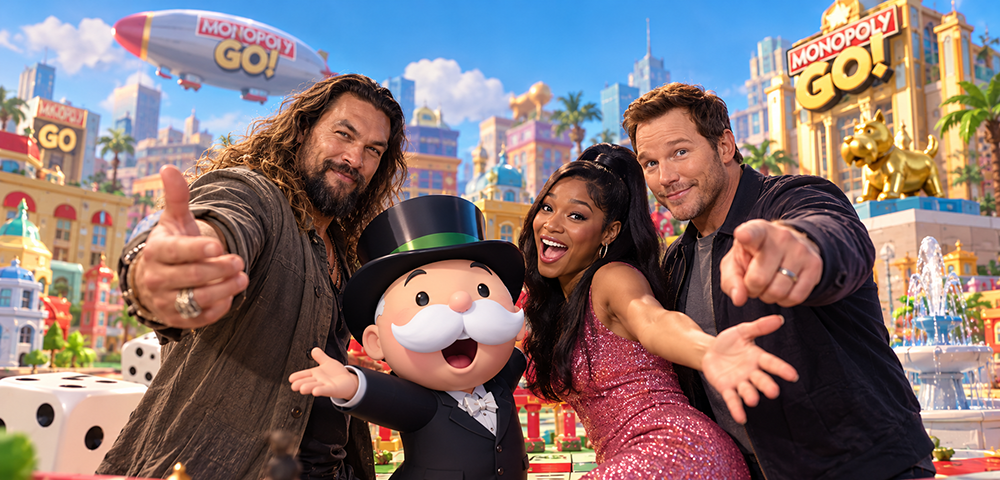
A game this profitable doesn't coast on word of mouth alone. In November 2024, Scopely and agency Omelet launched "Friendship Pays," MONOPOLY GO!'s first-ever global brand campaign — and it did not hold back. Jason Momoa, Keke Palmer, and Chris Pratt appeared as themselves (nicknamed "Momoney," "KeKe GoGo," and "Extra Chrispy"), while Will Ferrell signed on for a recurring role as the voice of an animated Mr. Monopoly.
The campaign ran across Monday Night Football, the Macy's Thanksgiving Day Parade, and NBC's holiday programming — prime real estate for reaching people who have never heard of a mobile game battle pass and never will. The ads dropped the celebrities into GoVille, a deliberately uncanny blend of real-world locations and the app's cartoon universe, built around in-game mechanics turned into physical bits: robbing a bank, breaking out of jail, racing toy-sized cars around a life-sized board, even gathering a group of exactly five people to crack open a Community Chest — the same way the app requires five players for its biggest team rewards.
Audience-measurement data on the first campaign backed up the strategy: viewer response skewed noticeably stronger among people who described themselves as infrequent gamers, not the hardcore mobile-gaming crowd — meaning the ads were doing exactly the job they were built for, pulling in a much wider "gen pop" audience who'd never otherwise see a mobile game ad.
The follow-up, 2025's "The Dice Life," doubled down with a full 90s-sitcom parody starring Jake Johnson and Sunita Mani, Will Ferrell still voicing Mr. Monopoly, and a deliberately goofy tone designed to feel nothing like a typical app-install ad — complete with an original theme song and knowing winks at classic sitcom tropes. The strategic logic, according to Scopely's own marketing lead, was simple: the product being sold isn't really the board or the dice. It's the promise that your actual friends are the content, and friendship, as the campaign's tagline insists, pays.
Then there's the detail that closes the loop in the strangest possible way: Hasbro has since turned MONOPOLY GO! back into a physical board game you can buy in stores — a mobile app, adapted from a board game, itself getting adapted back into a board game. Full circle, by way of several billion dollars.
Not everyone is cheering. Child-safety reviewers have been blunt about it: one widely-cited parent review called the design "textbook predatory," flagging the lack of any parental spending controls, prompts encouraging kids to connect their social contacts and address book for extra rewards, and a sticker-collecting system seemingly built to feel incomplete without paying. The game carries an ESRB "Everyone" rating — which covers content like violence and language, not monetization design, so it says nothing about any of this.
Player sentiment, once you look past the download charts, is also messier than the revenue suggests. Trustpilot and Change.org host a steady stream of complaints about reward balancing, difficulty completing sticker albums without paying, and customer service that players describe as dismissive — including petitions specifically asking Scopely to let players exchange excess duplicate stickers for ones they actually need, rather than leaving high-level accounts stuck for months on a single missing card. None of it has dented the business.
There's a broader regulatory backdrop worth noting too. Several markets — Belgium, the Netherlands, and parts of Asia among them — have spent the last few years tightening disclosure and age-gating rules specifically aimed at randomized, loot-box-style mechanics in games marketed to minors. MONOPOLY GO!'s sticker packs sit in an interesting gray zone relative to that debate: the drop mechanics are disclosed rather than hidden, which is meaningfully more transparent than a classic loot box, but the psychological pressure to keep opening them is, by design, just as real.
Scopely's catalogue also includes Stumble Guys, a battle-royale-style title especially popular with Gen Z and younger players — meaning the company's expertise in these exact mechanics isn't confined to an app mostly marketed to adults with nostalgia for a board game.
In fairness to MONOPOLY GO!, there's no pay-to-win advantage against other players and drop mechanics are disclosed rather than hidden. The criticism here isn't about secret odds. It's about a game engineered, with real precision, to make stopping feel worse than continuing — which is a different problem, and arguably a harder one to regulate. Ratings boards were built to flag violence and language; none of the major rating systems currently have a standardized way to flag "this app is unusually good at making children feel bad about not playing it."
None of this is unique to one studio or one game. It's the broader shape of modern free-to-play design. MONOPOLY GO! happens to be extraordinarily good at that particular tightrope walk. That's precisely why it's worth deconstructing rather than dismissing — the same mechanisms show up, in various disguises, in a huge share of the top-grossing charts. This one just assembled them with unusual precision, on top of a brand everyone already half-trusted.
Mobile gaming is an industry built on cloning whatever works. So why, more than three years on, is there still nothing else quite like MONOPOLY GO! sitting near the top of the charts?
It isn't for lack of trying. Scopely's own portfolio includes games built around Marvel, Disney, Warner Bros., Paramount, and WWE properties — a roster of licenses most studios would kill for. None of them have come close to MONOPOLY GO!'s trajectory. The difference isn't the size of the IP. Marvel and Disney are arguably bigger brands globally than a 90-year-old board game. The difference is that almost none of those other properties come pre-loaded with a mechanic as perfectly mobile-shaped as "roll dice, get richer, annoy your friends."
Partly, it's the license. Ninety years, 275 million physical copies sold, distribution in 113-plus countries — Hasbro handed Scopely a level of built-in global recognition that no new IP could buy at any price. Partly, it's the social graph: the entire revenge loop only works if you're playing against people you actually know, which means a competitor can't simply copy the mechanic without also somehow copying your friend list. Partly, it's time: six years and two scrapped prototypes is not a bet most studios have the patience to fund without a guarantee it'll work.
And partly, it's now just raw scale. A 500-person live-ops team funded by billions in existing revenue can ship overlapping events faster than a smaller, hungrier competitor ever could — which means the game's own success is what funds the relentless content cadence that keeps it successful. That flywheel, more than the dice or the stickers, might be the actual moat.
Scopely has used MONOPOLY GO!'s proceeds to go shopping, aggressively. The headline move was 2025's $3.5 billion purchase of Niantic's entire gaming division, Pokémon GO included, alongside Pikmin Bloom and Monster Hunter Now. That single deal, funded substantially by MONOPOLY GO!'s cash generation, helped push Scopely past $10 billion in lifetime company revenue and into position as the second-largest mobile games publisher on earth, behind only Tencent — roughly 3,000 employees now, all traceable back to a dice game nobody was sure would work.
The honest answer is nobody fully knows, including Scopely. Every live-service game eventually plateaus — Clash Royale took almost nine years to find its most recent growth spurt, and even MONOPOLY GO!'s own monthly numbers have cooled from their earliest, most explosive months into a steadier (if still enormous) $200-million-a-month cruise. The team's own public statements lean on the same idea that got them here in the first place: iterate constantly, measure everything, and treat every season as a chance to fix whatever's gone stale, rather than coast on brand recognition alone.
What's different this time is the size of the safety net. A studio that used to operate out of hallway cubicles now has a 500-person team, a parent company willing to fund a $3.5 billion acquisition off the back of this game's cash flow, and a direct line to Hasbro's entire toy box if MONOPOLY GO!'s particular well of nostalgia ever does run dry. Whatever comes after $8 billion, it's being built by a team that has already proven it's willing to throw away years of work rather than ship something merely good. That's a rarer asset in this industry than any single mechanic, dice roll, or celebrity campaign.
Six years. Two abandoned prototypes. A team that grew from a hallway to 500-plus people. The actual breakthrough wasn't a clever new mechanic — it was stripping out every bit of skill, compressing a two-hour tabletop commitment into an eleven-second phone turn, and replacing the strategy with dice, real friends, and a near-constant drip of things almost finished.